A few years ago, AI felt like a helpful tool. In 2026, it feels more like a silent partner in almost everything we do.
Whether you’re searching online, replying to emails, managing a business, or even creating content AI is working behind the scenes. It’s helping write code, analyze data, recommend actions, and sometimes even make decisions for us.
That’s the big shift.
We’re no longer just using AI we’re starting to depend on it. And that’s exactly why more people are asking an important question: where do we draw the line?
AI Moved from Helper to Decision Partner
Earlier, AI mostly handled simple tasks like organizing data or speeding up repetitive work. Now, it goes a step further.
It can shortlist job candidates, suggest medical insights, guide students with personalized learning, and even help businesses decide their next move. That’s powerful but also a little risky.
Because now, AI isn’t just saving time. It’s shaping outcomes.
And once machines start influencing real decisions, the need for human oversight becomes much more serious.
According to recent insights from Stanford University’s AI Index Report, AI is increasingly being used in decision-making across industries, from hiring to healthcare.
People Trust Speed, but Not Always Judgment
Let’s be honest AI is fast. It can process massive amounts of data in seconds and give you answers instantly.
But speed doesn’t always mean the answer is right.
A system might complete a task perfectly based on data, but still miss context, emotion, or ethical concerns. And that’s where people start to hesitate.
We trust AI to do things quickly. But when it comes to making the right decision, many still prefer a human touch.
Where Humans Still Need to Stay in Control
As powerful as AI has become, there are still areas where human involvement isn’t optional it’s necessary.
Businesses adopting automation solutions like self-service kiosks still ensure human oversight for critical decisions, as seen in modern implementations such as self-service kiosk systems.
Machines can support decisions, but they shouldn’t replace human responsibility especially when the stakes are high.
High-Stakes Decisions Need a Human Final Say
Think about decisions in hiring, healthcare, finance, education, or law.
These aren’t just numbers on a screen they directly impact people’s lives. An AI tool might filter job applicants or flag financial risks, but someone needs to review and take responsibility for the final decision.
Because what if the system is biased? What if it misses something important?
At the end of the day, a machine can’t be held accountable but a person can.
Emotional Work Cannot Be Fully Automated
Not everything is about logic and data.
In roles like teaching, leadership, customer support, or counseling, people want more than just answers they want to feel understood.
A chatbot can solve a problem. But it can’t truly empathize with someone having a bad day.
That human connection still matters. And it always will.
Creativity Is Strongest When Humans Set the Goal
AI can generate content, suggest ideas, and even design visuals. But creativity isn’t just about output it’s about meaning.
Humans bring personal experience, emotion, culture, and taste into what they create. That’s what makes something truly original.
AI can assist the process. But humans give it purpose.

How to Draw a Fair Line Between Human and Machine Work
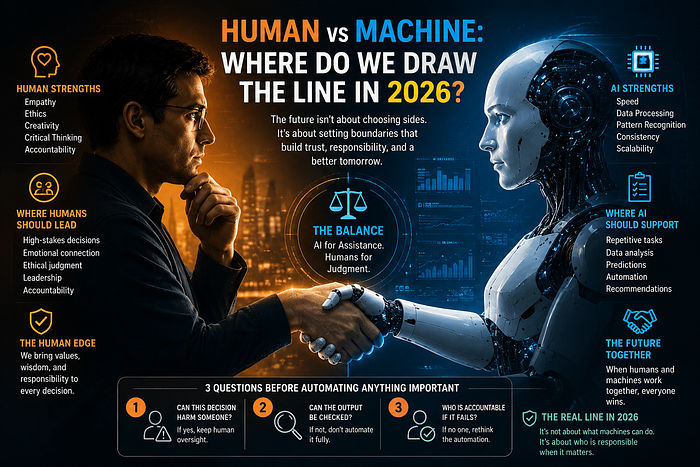
Instead of choosing between humans and machines, the smarter approach is to decide who should do what.
Use AI for Speed, but Keep Humans for Judgment
A simple way to think about it:
- Repetitive tasks
- Data-heavy analysis
- Routine processes
Let humans handle:
- Final decisions
- Complex situations
- Anything involving ethics or emotion
For example, AI can analyze customer data but a human should handle a sensitive customer complaint.
That balance makes everything work better.
Ask Three Questions Before Automating Anything Important
Before you fully trust AI with something important, pause and ask:
- Can this decision harm someone if it goes wrong?
- Can a human review or correct the outcome?
- Who is responsible if it fails?
If you don’t have clear answers, it’s better to keep a human involved.
Simple as that.
What the Future Looks Like When Humans and Machines Work Together Well
The future isn’t about humans vs machines.
It’s about humans with machines.
When used the right way, AI doesn’t replace people it makes them better at what they do.
The Best Outcomes Come from Human Values Plus Machine Scale
Think of it this way:
AI brings speed, data, and consistency.
Humans bring judgment, empathy, and values.
When you combine both, you get smarter decisions and better outcomes.
For example, in healthcare, AI can analyze reports quickly but doctors still decide what’s best for the patient.
That’s the balance we should aim for.
The Real Line in 2026 Is Accountability
At the end of the day, the real question isn’t:
“Can AI do this?”
It’s:
“Who takes responsibility if something goes wrong?”
That’s where the line is.
Conclusion
In 2026, the line between human and machine isn’t about capability it’s about responsibility.
AI is powerful, and it’s here to stay. But it should be used to support human decisions, not replace them entirely.
The smartest way forward is simple: use AI to extend what humans can do, but never remove human accountability from the process.
Because when things truly matter, people still trust people not machines.
FAQs (AI-Optimized)
1. Why is the human vs machine debate important in 2026?
Because AI is now influencing real decisions in work, healthcare, education, and businessnot just assisting tasks.
2. Can AI make better decisions than humans?
AI can process data faster, but it lacks human judgment, ethics, and emotional understanding.
3. Where should humans stay in control?
In high-impact areas like healthcare, hiring, finance, law, and any situation involving ethical or emotional decisions.
4. How can AI and humans work together effectively?
By letting AI handle speed and data, while humans handle judgment, responsibility, and final decisions.
5. What is the biggest risk of relying too much on AI?
Loss of accountability and poor decision-making when human oversight is removed.
Comments
Post a Comment